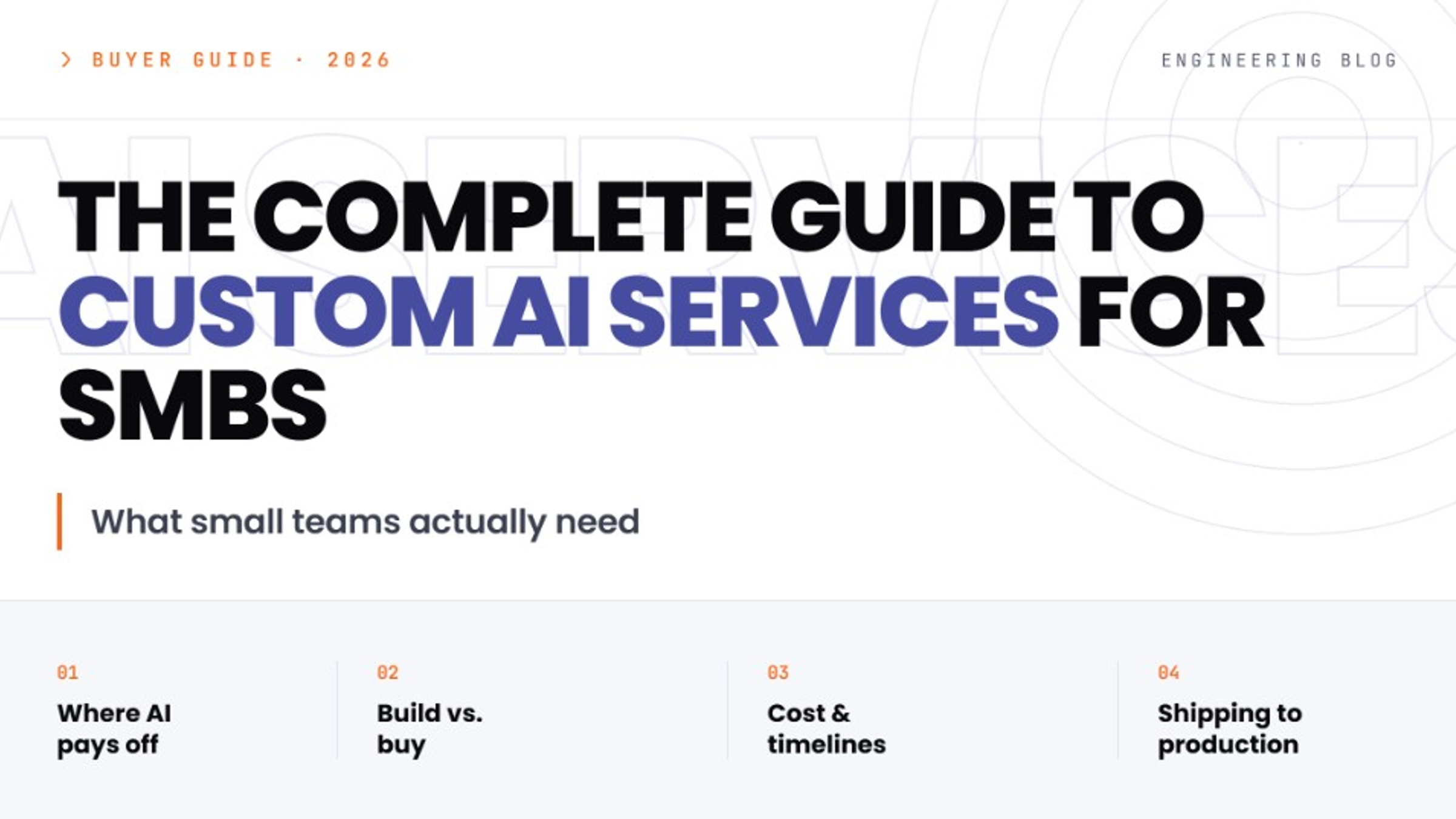
The Complete Guide to Custom AI Services for SMBs (2026)
A practical guide to custom AI development services for SMBs — workflow automation, software integration, evaluation criteria, and measurable outcomes.
Most SMB leaders don't actually need "more AI." They need three or four specific, recurring problems solved: too much manual work in a process that hasn't scaled, data trapped in systems that don't talk to each other, and decisions being made on gut feel because nobody has time to pull a real report. Custom AI development services exist to solve exactly that class of problem — not to add a chatbot to your website because a competitor has one.
This guide covers what custom AI actually means for a small or mid-sized business, where it delivers real value versus where an off-the-shelf tool is the smarter call, how to evaluate a development partner, and what a realistic engagement actually looks like from first conversation to measured outcome — the practical version of what AI business growth solutions usually means once the marketing language is stripped away.
What "custom AI" actually means for an SMB
Custom AI development means building software — an agent, an automation, a data pipeline — tailored specifically to your business's data, workflows, and systems, rather than configuring a generic SaaS tool built for a broad market and hoping it fits.
The distinction matters more than it sounds. A generic AI tool is trained and designed around population-level patterns: what works for the average business in your category. A custom system is built around your specific customer behavior, your specific operational bottlenecks, and your specific existing software stack. For a business with meaningful first-party data and a genuinely specific workflow, that difference in fit compounds over time in a way a subscription tool can't match.
This doesn't mean every SMB needs custom AI. A five-person business with a standard sales process is often well served by an existing CRM's built-in AI features. AI software development for SMBs earns its cost specifically when the business has outgrown generic tools, or when the workflow is specific enough that no off-the-shelf product actually fits it well.
Where custom AI delivers real value for SMBs
Business workflow automation
This is the most common entry point, and usually the fastest to show measurable return. Business workflow automation replaces the manual, repetitive steps that quietly consume hours every week: reconciling data between two systems, manually triaging incoming support requests, generating reports that currently require someone to open five different tools and assemble the numbers by hand. The value isn't automation for its own sake — it's freeing a person who's currently doing rote work to do something that actually requires judgment. A well-scoped automation project typically pays for itself in staff time within the first several months, not years.
Software integration
Most SMBs run on a patchwork of tools — a CRM, an accounting platform, an e-commerce system, a support desk — each holding a piece of the picture with no clean way to see them together. Software integration work connects these systems so data flows automatically instead of requiring manual export-and-reconcile work, and it's often the unglamorous foundation that makes every other AI initiative actually work. An AI agent that's supposed to make smart decisions but only has access to half your business data will make confidently wrong recommendations.
Data-driven decision making
Once workflows are automated and systems are connected, the next layer is turning that unified data into something a founder or operations lead can actually act on: forecasting, anomaly detection, and recommendations — not just another dashboard. Genuine data-driven decision making means the system tells you what's happening and what to do about it, not just what happened last month in a report nobody has time to fully read.
Xorora typically starts SMB engagements at the workflow and integration layer — through workflow automation and AI agent development — before layering predictive or recommendation logic on top of data that actually flows cleanly.
Industry-specific applications worth knowing
Custom AI's value shows up differently depending on the vertical. A few examples worth understanding, even if your business sits in a different industry, since the underlying pattern usually transfers:
Healthcare operations optimization
Small and mid-sized healthcare practices and healthcare-adjacent businesses face some of the highest-value automation opportunities anywhere: scheduling and no-show prediction, insurance eligibility verification, clinical documentation support, and compliance monitoring that turns regulatory changes into actionable alerts instead of a manual review process. The margin for error is also higher here, which makes production-grade engineering (not a quick prototype) genuinely non-negotiable.
E-commerce and retail
Inventory forecasting, dynamic pricing, and customer service automation that actually resolves issues rather than just routing tickets.
Professional services
Automated intake and qualification, document generation, and billing reconciliation across client engagements.
Logistics and field operations
Route optimization, predictive maintenance alerts, and automated status updates that reduce manual check-ins.
The common thread across all of these: the highest-value custom AI projects sit at the intersection of a genuinely painful manual process and data the business already has but isn't using well.
How to evaluate a custom AI development partner
Ask what changes between a demo and a production system
A working prototype and something reliable enough to run your actual operations are different deliverables. A partner should be able to explain concretely what production-hardening involves, not wave the question away.
Check for real, referenceable production work
Ask to see a system handling real business data at real volume, and ask what happened when something broke — not just a features list.
Confirm they can handle both the AI layer and the integration work
An AI recommendation engine that can't actually see your CRM or accounting data isn't useful. Ask directly whether the team handles the surrounding software integration work or expects you to have that solved already.
Get a clear, scoped estimate — not a vague range
Cost should be tied to your specific workflows and systems, not a generic "AI project" price. If a vendor can't scope your project without understanding your actual data and process, that's a signal worth noting.
Ask how success gets measured
A serious partner will want to define a measurable outcome (hours saved, error rate reduced, response time improved) before the project starts, not after.
Clarify what happens after launch
Systems need tuning as real usage reveals edge cases the initial build didn't anticipate. Ask whether ongoing iteration is part of the engagement or a separate, unstated cost.
What a realistic engagement looks like
A well-run custom AI engagement for an SMB typically moves through a few clear phases: a discovery conversation to understand your actual workflows and data (not a generic sales pitch), a scoped proposal tied to a specific, measurable outcome, a build phase with regular checkpoints rather than a black-box handoff, and a launch that includes monitoring and a plan for iteration — not just a one-time delivery.
For a single, well-defined automation or integration, a realistic timeline runs from several weeks to a couple of months. Larger, multi-system builds naturally take longer. Be wary of either extreme: a quote that promises a complex custom system in a week, or a proposal so vague it can't commit to a timeline at all. If you're still clarifying whether custom is the right path, a short AI consultation or MVP / POC is often the fastest way to de-risk the decision before a full build.
Custom AI development at Xorora
Xorora is a US-based AI development partner offering custom AI development services built specifically for growth-focused SMBs that have outgrown generic tools. Its work spans workflow automation, custom application development, and AI agent development, built as one connected system rather than separate, disconnected deliverables.
Relevant production work includes a real-time compliance intelligence platform that turns regulatory changes into live, actionable alerts — directly relevant to businesses in healthcare or other compliance-heavy operations — and real-time event monitoring infrastructure built for instant, full-context alerting rather than delayed reporting. Publicly cited results across Xorora's engineering work include a 3.5x median speed-up compared to building the same system in-house and 99.9% uptime across deployed systems.
What this looks like in practice for an SMB
- A $10,000 minimum project size keeps the door open for a single, well-scoped automation or integration — not only a full platform build
- The team handles both the AI layer and the underlying software integration work, so a recommendation engine or agent actually has access to your real business data
- Teams that already have staff in place and just need extra capacity can use staff augmentation instead of a full project handoff
- Ongoing iteration is part of how engagements are structured, not an unstated extra cost discovered after launch
If you're trying to figure out whether your business's specific bottleneck is actually worth a custom build, or whether an off-the-shelf tool would genuinely serve you just as well, get in touchfor a scoping conversation. That honest assessment costs you nothing — and it's usually the fastest way to know which path actually makes sense.
Frequently asked questions
Q1: What is included in custom AI development services?
A full engagement typically includes discovery and workflow analysis, system architecture and design, the AI/automation build itself, integration with existing software (CRM, accounting, e-commerce, or other business systems), testing, deployment, and a plan for post-launch monitoring and iteration. The best partners treat the AI layer and the surrounding software integration as one connected deliverable, not two separate projects.
Q2: Is custom AI development worth it for a small business, or should I use off-the-shelf tools?
It depends on how specific your workflow is and how much first-party data your business already has. A standard process well served by an existing tool's built-in AI features usually doesn't need a custom build. Custom development earns its cost when your workflow is specific enough that no off-the-shelf product fits well, or when you've outgrown what generic tools can do.
Q3: How much does custom AI development cost for an SMB?
Cost depends on scope: a single, well-defined automation or integration costs meaningfully less than a multi-system build spanning several business processes. Get a written estimate against your specific workflows and systems rather than a generic price range, since integration work often accounts for a significant share of total project cost.
Q4: How long does a typical custom AI project take?
A single, well-scoped automation or integration typically takes several weeks to a couple of months. Larger builds spanning multiple systems take longer. Be cautious of quotes promising a complex custom system in an unrealistically short timeframe.
Q5: Can custom AI help with healthcare operations optimization specifically?
Yes. Common applications include scheduling and no-show prediction, insurance eligibility verification, documentation support, and compliance monitoring that turns regulatory changes into actionable alerts. Because the margin for error is higher in healthcare, production-grade engineering discipline matters more than in lower-stakes categories.
Q6: What's the difference between business workflow automation and a full custom AI system?
Workflow automation typically means replacing manual, repetitive steps with automated ones — often the fastest, most measurable starting point. A full custom AI system usually adds a decision-making or predictive layer on top, using automated, connected data to actually recommend or trigger the next action — closer to genuine data-driven decision making than task automation alone.
Q7: Is Xorora a good choice for custom AI development services?
Xorora builds workflow automation, software integration, and AI agent systems together for growth-focused SMBs, rather than treating each as a separate project. It's a strong fit for businesses that have outgrown generic tools and need a system built specifically around their own data and processes. Projects start at $10,000, with pricing quoted directly against scope.