Best AI Analytics Tools for Amazon Sellers Compared (2026)
Compare AI analytics and decision support systems for Amazon and e-commerce sellers on data depth, decision-support intelligence, and SMB fit.

Software Development at Xorora
Zarrar Ahmad writes about custom software, AI product delivery, and how engineering teams choose the right dev…
- Updated:
- Published:
Quick answer: The strongest AI analytics and decision support systems for Amazon and e-commerce sellers score well on three things: data depth (how complete and accurate the underlying numbers actually are), decision-support intelligence (whether the tool tells you what to do next, or just shows you a dashboard), and SMB fit (whether a small team without a dedicated data analyst can actually run it day to day). Helium 10, Jungle Scout, SmartScout, SellerApp, Perpetua/Quartile, and Sellerboard are scored against all three below, alongside when a custom-built system outperforms all of them.
Who this comparison is for
This is written for e-commerce and digital retail brands — mostly Amazon sellers — evaluating AI-powered analytics platforms to replace spreadsheets, guesswork, or a patchwork of half-used tools. If you're a founder or ops lead trying to make faster, better-informed calls on pricing, inventory, and ad spend, this comparison is built around the decision you're actually making: which platform, if any, is worth paying for.
The three criteria that actually matter
Most "best tools" roundups list features. Features don't tell you whether a platform will actually change how your business makes decisions. Three criteria do:
1. Data depth
How complete is the underlying data, and how current is it? A dashboard built on delayed or partial data produces confident-looking numbers that are quietly wrong, which is worse than no dashboard at all.
2. Decision-support intelligence
This is the difference between business intelligence (a dashboard that shows you what happened) and a genuine decision support system (a tool that tells you what to do about it — reorder now, cut this ad group, raise this price). Most "AI-powered" tools are still BI with a chatbot bolted on. A smaller number actually generate recommendations you can act on directly.
3. SMB fit
Can a small team run this without hiring a data analyst? Pricing, setup complexity, and the learning curve all matter more for a 5-person brand than a 500-person one. A tool built for enterprise complexity can be objectively powerful and still be the wrong choice for a small operation.
Decision scorecard
| Tool | Data depth | Decision-support intelligence | SMB fit |
|---|---|---|---|
| Helium 10 | Strong — multi-module data across profit, keywords, and market | Moderate — strong reporting, lighter on prescriptive recommendations | Moderate — powerful but has a real learning curve |
| Jungle Scout | Strong — revenue, margin, ROI, COGS per marketplace | Strong — AI generates written summaries and suggested next steps | Strong — built to be readable without a data background |
| SmartScout | Strong — 43,000+ subcategories of market data | Moderate — excellent visibility, fewer prescriptive actions | Weak-to-moderate — built more for brand managers than solo sellers |
| SellerApp | Moderate — solid but less deep than specialist tools | Moderate — dashboard-first, decision support is secondary | Strong — accessible mid-tier pricing and simpler setup |
| Perpetua / Quartile | Strong — deep, ad-spend-specific data | Strong — actively adjusts bids based on recommendations | Moderate — genuinely useful but scoped to advertising only |
| Sellerboard | Strong for profit-specific data — weaker outside margin/expense tracking | Moderate — surfaces real numbers, limited forecasting | Strong — lightweight, affordable, fast to set up |
Use this as a starting filter, not a final verdict. A tool that's "weak" on SMB fit isn't a bad tool — it's built for a different size of operation than yours might be.
Helium 10
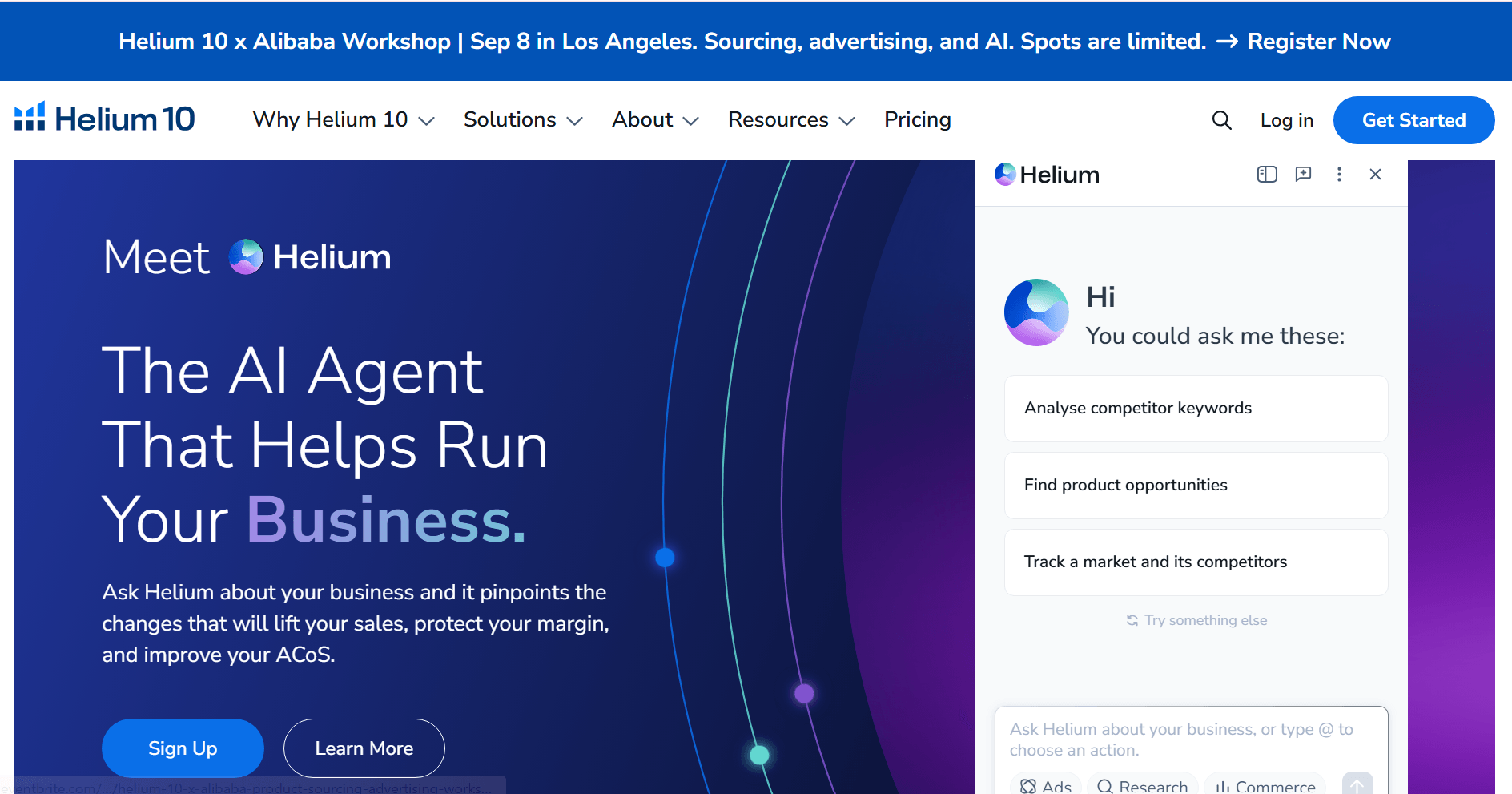
- Data depth
- Strong — multi-module data across profit, keywords, and market
- Decision-support intelligence
- Moderate — strong reporting, lighter on prescriptive recommendations
- SMB fit
- Moderate — powerful but has a real learning curve
Helium 10 is generally considered the most complete Amazon analytics suite available, bundling Profits, Market Tracker, and Keyword Tracker into one platform. It pulls together sales volume, gross revenue, expenses, and net profit across marketplaces in one place, which is exactly the kind of consolidated view that otherwise requires stitching together spreadsheets manually.
Strengths
Broadest single-platform data coverage, strong keyword and market tracking layered in alongside profit data.
Trade-off
More reporting than active decision support, and the depth of features means a real onboarding curve for a small team.
Jungle Scout
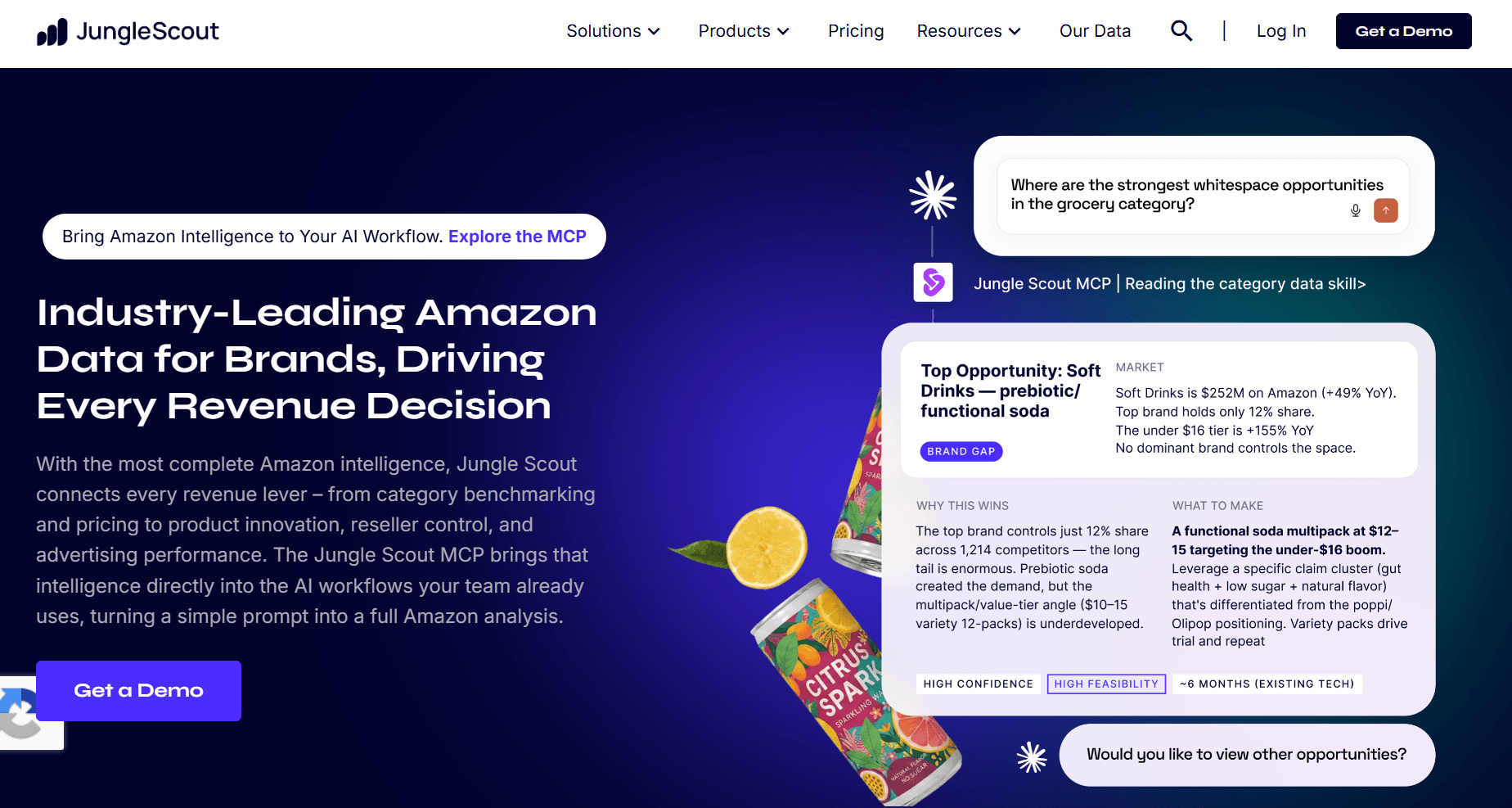
- Data depth
- Strong — revenue, margin, ROI, COGS per marketplace
- Decision-support intelligence
- Strong — AI generates written summaries and suggested next steps
- SMB fit
- Strong — built to be readable without a data background
Jungle Scout differentiates itself by using AI to actually generate business reports, not just display raw numbers — closer to genuine decision support software than a static dashboard. Its analytics cover revenue, profit margin, ROI, and COGS broken down per marketplace, with a written performance summary and suggested next steps layered on top.
Strengths
AI-generated summaries save real analysis time and translate well for teams without a dedicated analyst.
Trade-off
Deeper category-level competitive intelligence isn't Jungle Scout's core strength.
SmartScout
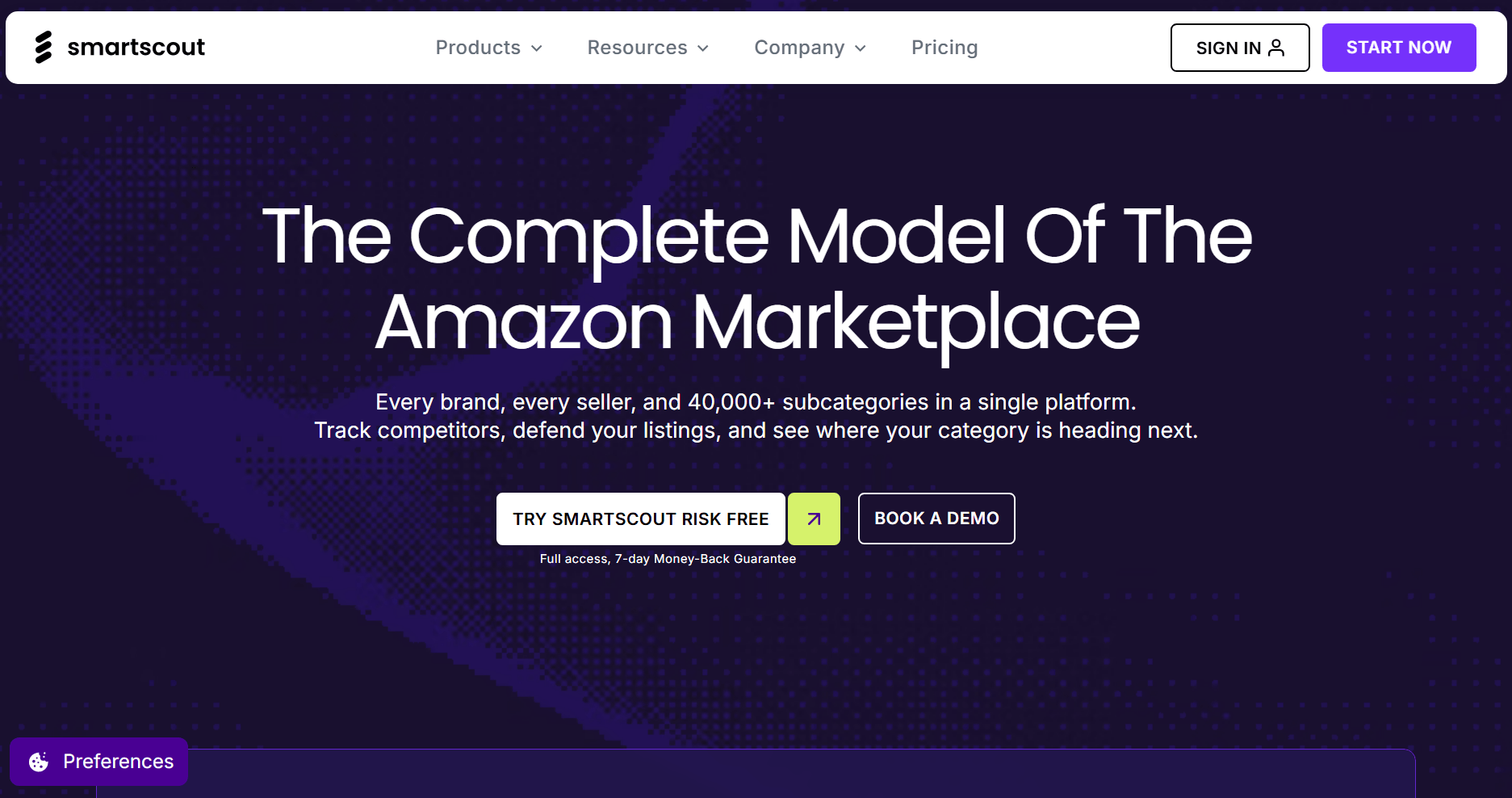
- Data depth
- Strong — 43,000+ subcategories of market data
- Decision-support intelligence
- Moderate — excellent visibility, fewer prescriptive actions
- SMB fit
- Weak-to-moderate — built more for brand managers than solo sellers
SmartScout's differentiator is scale of market intelligence: historical market-share data spanning more than 43,000 subcategories, giving brand managers visibility into category trends and competitor movement over time.
Strengths
Category and competitive intelligence depth that smaller, single-brand-focused tools can't match.
Trade-off
Built more for brand-level strategic visibility than day-to-day, prescriptive decision-making for a small team.
SellerApp
- Data depth
- Moderate — solid but less deep than specialist tools
- Decision-support intelligence
- Moderate — dashboard-first, decision support is secondary
- SMB fit
- Strong — accessible mid-tier pricing and simpler setup
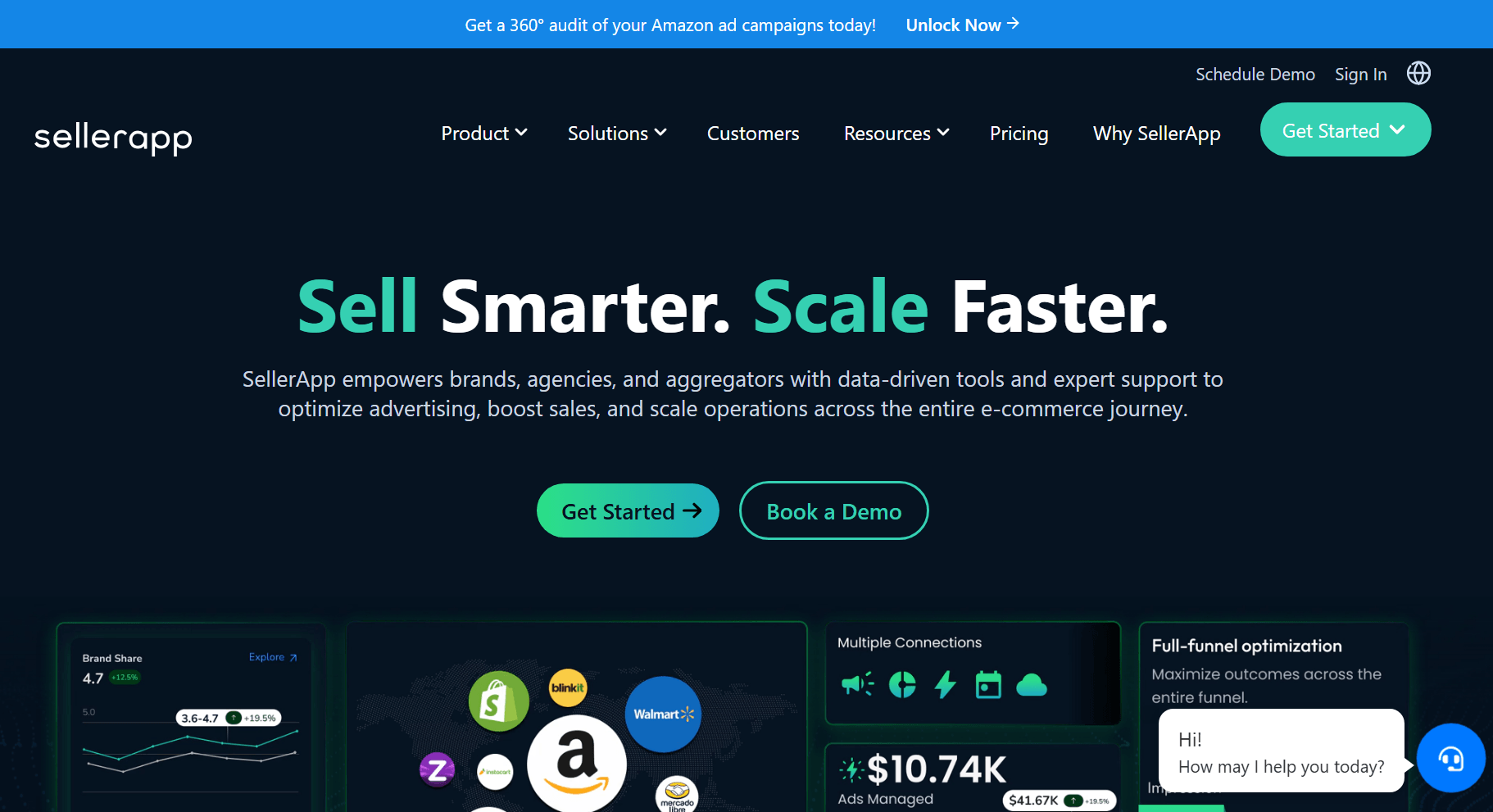
SellerApp positions itself as a mid-tier all-rounder, combining product research, listing support, and analytics in one dashboard — a reasonable pick among SMB analytics solutions for sellers who don't need Helium 10's full depth but want more than a single-purpose tracker.
Strengths
Balanced feature set without the premium pricing of the largest suites.
Trade-off
Individual analytics features tend to be less deep than a specialist tool built around just one function.
Perpetua and Quartile
- Data depth
- Strong — deep, ad-spend-specific data
- Decision-support intelligence
- Strong — actively adjusts bids based on recommendations
- SMB fit
- Moderate — genuinely useful but scoped to advertising only
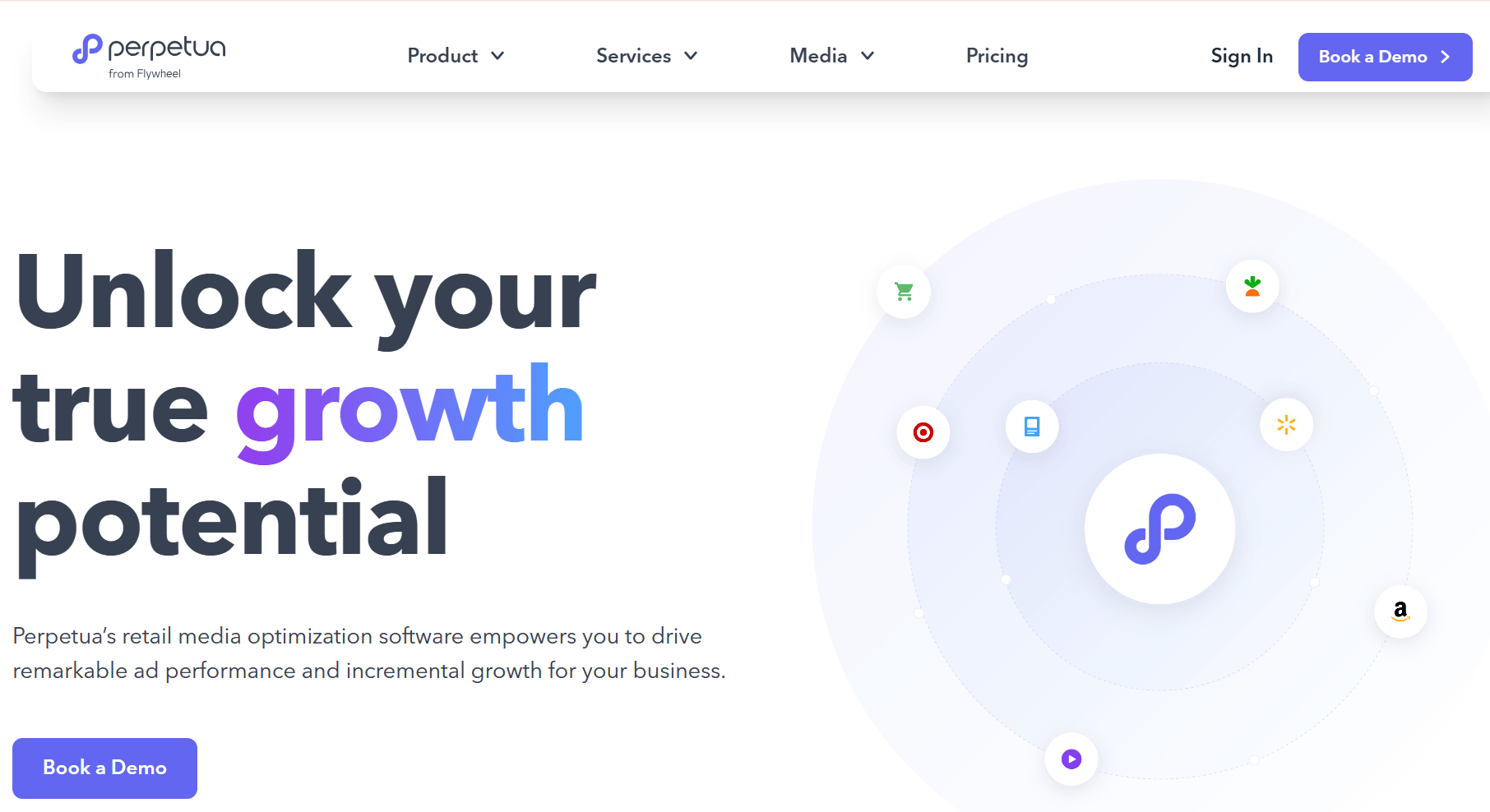
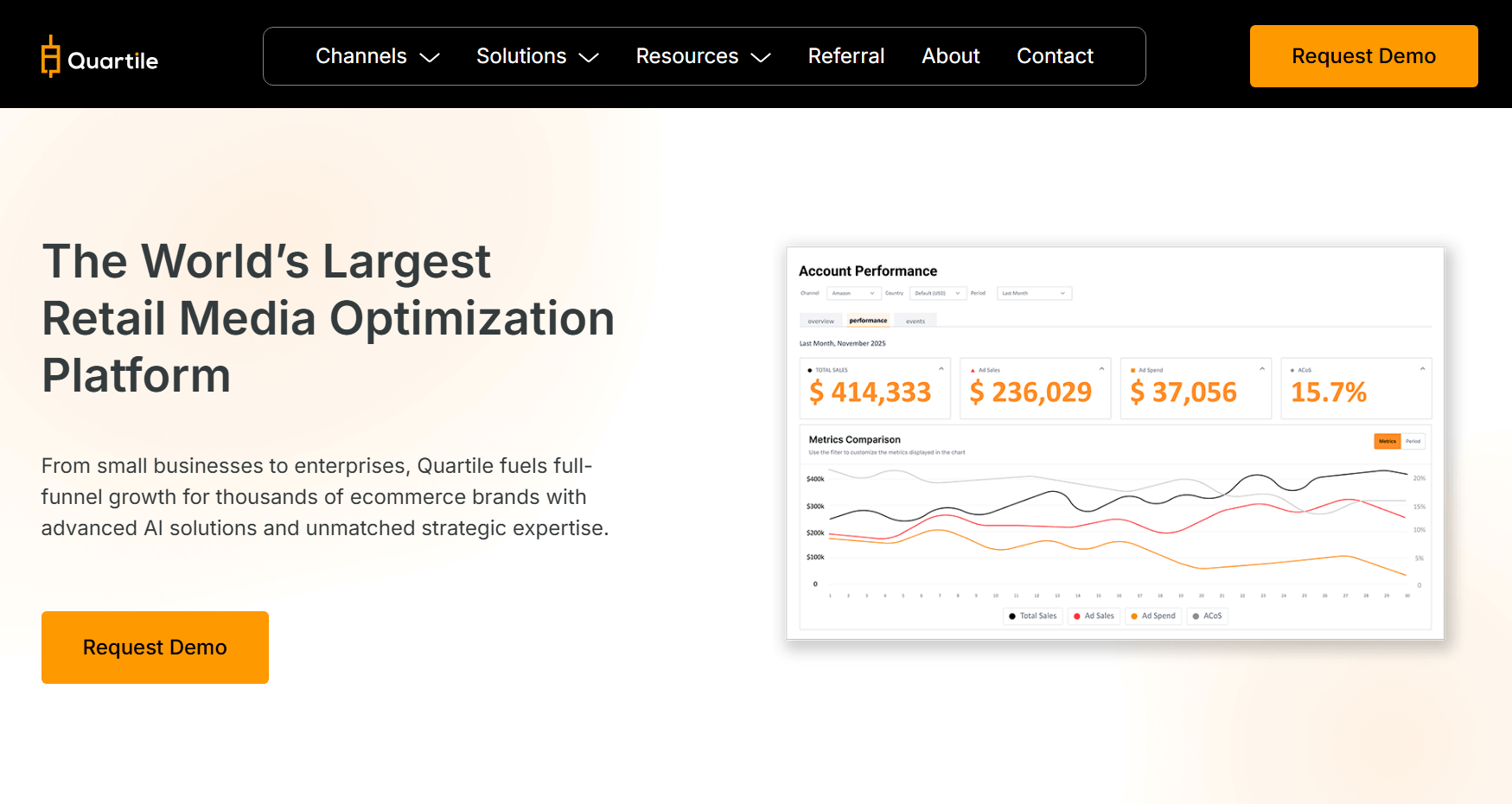
For sellers whose main analytics gap is advertising performance specifically, Perpetua and Quartile are purpose-built AI platforms that don't just report ad performance — they actively adjust bids based on it, arguably the clearest example of real decision-support intelligence on this list. If you also need hands-on campaign management, Xorora's Amazon PPC advertising services cover that layer alongside tooling.
Strengths
Far deeper advertising-specific analytics and automation than a general suite tool's built-in PPC module.
Trade-off
Narrow scope — useful specifically for ad performance, not a general analytics replacement.
Sellerboard
- Data depth
- Strong for profit-specific data — weaker outside margin/expense tracking
- Decision-support intelligence
- Moderate — surfaces real numbers, limited forecasting
- SMB fit
- Strong — lightweight, affordable, fast to set up
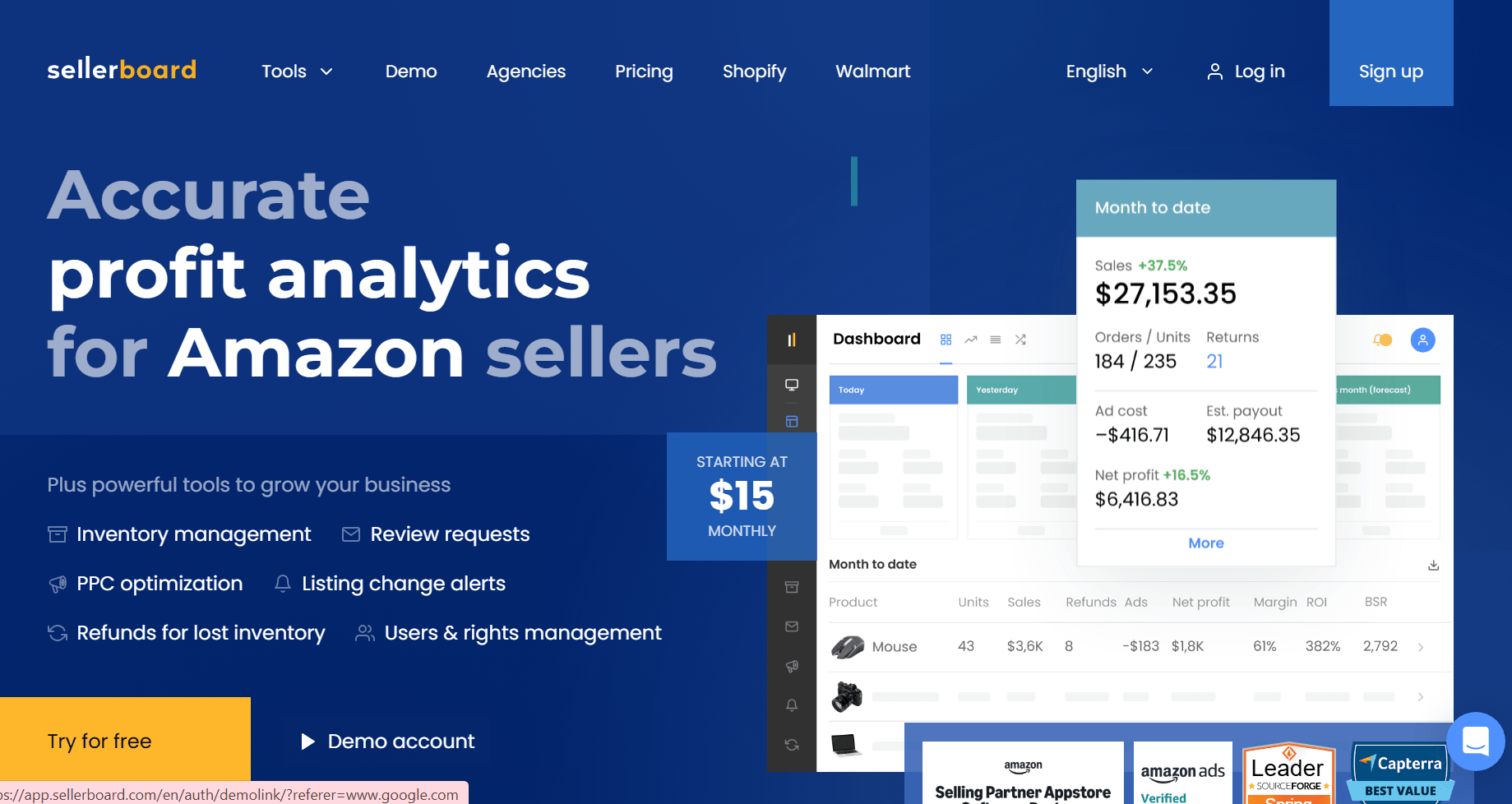
Sellerboard has built a following as a lightweight, dedicated profit and expense dashboard, tracking real-time profitability including the hidden fees (returns, storage, advertising costs) that inflate-looking revenue numbers often hide.
Strengths
Focused, affordable, and genuinely good at the one thing it's built for: knowing your real margin per SKU, with minimal setup effort.
Trade-off
Doesn't attempt product research, PPC optimization, or forward-looking forecasting — it's retrospective analytics by design.
How to choose the right system for your business
Start with what decision you're actually trying to make better
"What's my real profit per SKU" points toward Sellerboard or Helium 10's Profits module. "How's my category performing against competitors" points toward SmartScout. "Is my ad spend working, and should it change automatically" points toward Perpetua or Quartile.
Weigh BI against genuine decision support
If you want a platform that tells you what happened, most of these tools qualify. If you want one that tells you what to do next and can act on it, Jungle Scout's AI reporting and Perpetua/Quartile's automated bid adjustment are the closer fit.
Be honest about your team's capacity
A powerful, feature-dense platform that nobody has time to fully learn produces less value than a simpler tool your team actually opens every day. Data-driven decision making only works if the data gets looked at.
Weigh subscription cost against your order volume
A $99–$695/month tool makes obvious sense once you're processing enough orders that the time saved outweighs the cost. For a smaller catalog, a lighter, cheaper tool — or a custom-built system scoped to exactly what you need — can be the more rational choice.
When off-the-shelf isn't enough: custom decision support systems
For most sellers, one or two of the tools above genuinely cover the need. But brands running multiple marketplaces, multiple product lines, or a business intelligence stack that has to sit alongside internal systems (ERP, custom reporting, a proprietary pricing model) often hit a ceiling with subscription tools: the dashboard shows what the vendor decided to build, not necessarily the decision support your specific business actually needs.
That's where a custom AI analytics build becomes the more sensible option instead of paying for three overlapping subscriptions and still not getting the exact view you need. Xorora builds custom application and dashboard development for e-commerce and digital retail brands whose data needs don't fit a generic seller tool, pulling data directly from Amazon's Selling Partner API, your accounting system, and any other source into one unified, purpose-built system rather than three logins and three exports you have to reconcile manually. Sellers who also need ongoing account operations can pair that with Amazon account management.
Xorora's relevant work includes a real-time SaaS event monitoring system built for instant, full-context alerting — exactly the kind of infrastructure that powers a live profit-and-inventory system rather than a report you have to remember to check. Publicly cited results across Xorora's broader engineering work include a 3.5x median speed-up compared to building the same system in-house and 99.9% uptime across deployed systems. For forecasting and anomaly detection layered on top of seller data, see also ML & data science services.
When a custom decision support system makes more sense than another subscription
- You're running multiple brands or marketplaces and need one unified view, not several tool logins
- Your data needs to combine Amazon data with internal systems (accounting, inventory, CRM) that off-the-shelf tools don't integrate with
- You've outgrown what a generic dashboard shows and need AI-driven forecasting or anomaly detection built specifically around your SKUs and margins — real decision support, not just reporting
- You're paying for three overlapping subscriptions and still assembling the real picture manually in a spreadsheet
A scoped build starts at $10,000, with pricing quoted against your actual data sources and reporting needs. Teams that already have engineers or analysts in place can also bring in extra capacity through staff augmentation rather than a full build handoff. If you want to see whether a custom system would actually beat your current tool stack, get in touch for a scoping conversation.
Frequently asked questions
Q1: What is an AI analytics and decision support system?
It's software that goes beyond a static dashboard, using AI to analyze business data and actively recommend or trigger actions — adjusting an ad bid, flagging a reorder point, surfacing an anomaly — rather than just displaying historical numbers for someone to interpret manually. The strongest AI analytics and decision support systems combine deep, accurate data with genuinely prescriptive recommendations, not just AI-generated summaries of the same old dashboard.
Q2: What's the difference between business intelligence and a decision support system?
Business intelligence tells you what happened: revenue, margin, traffic, broken down and visualized. A decision support system goes a step further, using that data to recommend or automate a next action. Most Amazon seller tools sit somewhere on that spectrum; Jungle Scout and Perpetua/Quartile lean furthest toward genuine decision support among the tools compared here.
Q3: What's the best SMB analytics solution for a small Amazon brand?
For most small teams without a dedicated analyst, Jungle Scout's AI-generated reporting or Sellerboard's lightweight profit dashboard are the most accessible starting points. Helium 10 and SmartScout offer more depth but come with a steeper learning curve, better suited to teams with more bandwidth to dedicate to the platform.
Q4: How much do AI analytics tools for Amazon sellers cost?
Pricing varies widely by category. Broad analytics suites typically start around $99/month on an annual plan. Specialist advertising analytics platforms range from roughly $49 to several hundred dollars a month depending on ad spend and feature tier. Lighter, single-purpose profit trackers are generally more affordable than full research-and-listing suites.
Q5: When does a custom decision support system make more sense than a subscription tool?
When your data needs span multiple brands or marketplaces, need to combine Amazon data with internal systems a generic tool doesn't integrate with, or require forecasting and anomaly detection built specifically around your own SKUs and margins rather than a generic dashboard view.
Q6: Can Xorora build a custom AI analytics and decision support system?
Yes. Xorora builds custom analytics and decision-support systems that pull data from Amazon's Selling Partner API and other business systems into a single, purpose-built view designed to support data-driven decision making, not just reporting. Projects start at $10,000, with pricing quoted directly against your data sources and reporting requirements.
Related
Related articles
Best Custom AI Firms for SaaS Products Compared (2026)
Software Development·12 min read
Compare AI software development companies for SaaS on design capability, deployment capability, and scaling capability across the full AI agent lifecycle.
Oct 2, 2026
Best AI Agent Providers for Agency Client Automation (2026)
Software Development·12 min read
Compare AI agent development services for agencies on deployment repeatability, per-client customization, and operational reliability at scale.
Sep 30, 2026
The Complete Guide to Custom AI Services for SMBs (2026)
Software Development·11 min read
A practical guide to custom AI development services for SMBs — workflow automation, software integration, evaluation criteria, and measurable outcomes.
Sep 14, 2026