
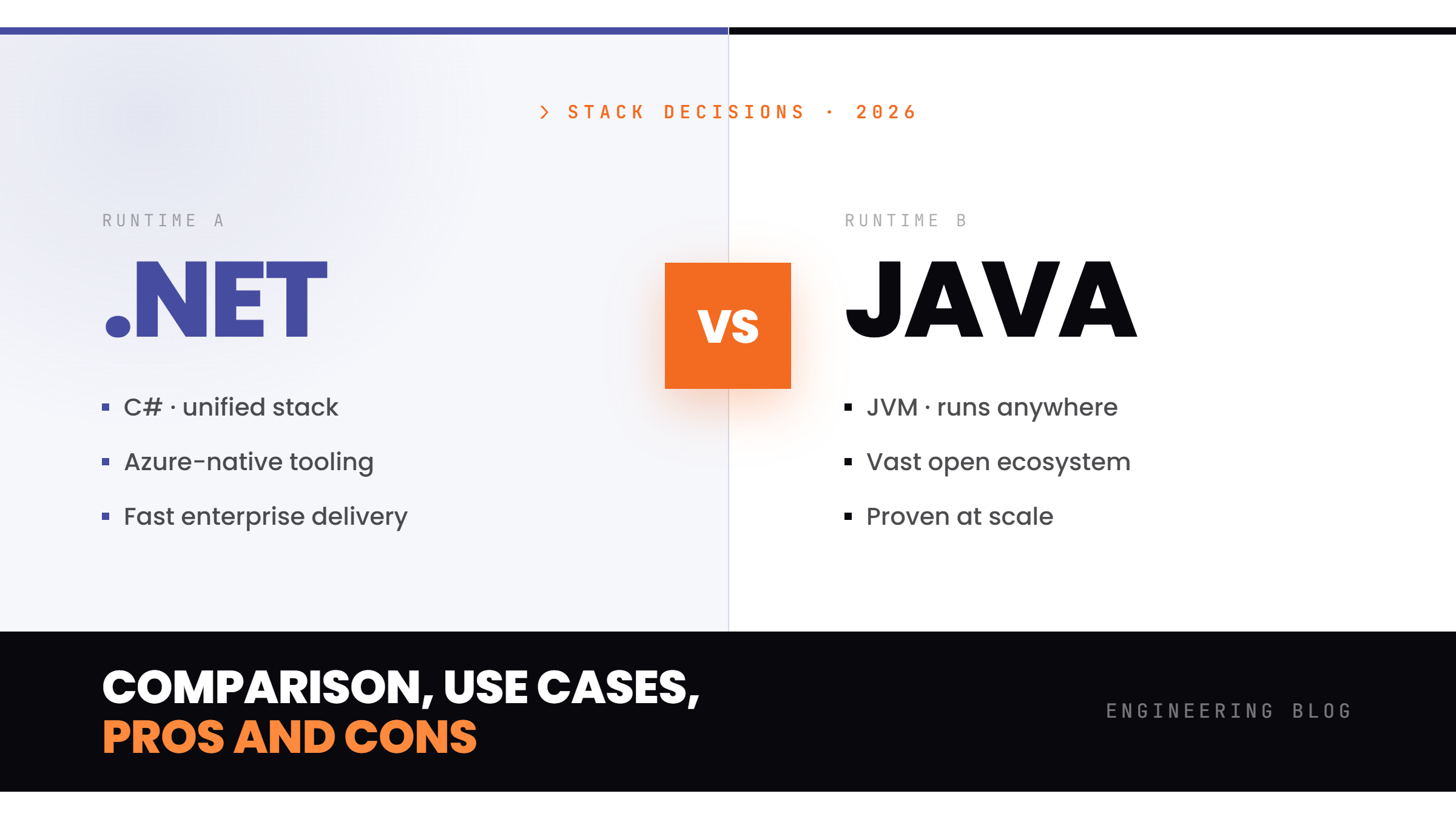
If you're comparing .NET vs Java for an upcoming project, you've probably already noticed the problem: every guide claims to give you a straight answer, and most of them quietly favor whichever platform the agency writing the guide happens to specialize in. That's not useful when you're the one signing off on a multi-year technical decision.
This guide skips the bias. Xorora builds production systems in both .NET and Java, alongside Python, Node.js, and Laravel, so this comparison isn't written to steer you toward one "house stack." It's written to help you answer the actual question underneath net vs java: which platform fits your team, your infrastructure, your performance requirements, and your five-year maintenance horizon.
We'll cover what each platform is, honest pros and cons, a full dot net vs java comparison table, real performance differences (including c# vs java speed and c# vs java performance), cost, use cases, and where AI and machine learning capability now factor into the decision.
What is .NET?
.NET is Microsoft's open-source, cross-platform development platform, built primarily around the C# language (with F# and VB.NET also supported). Modern .NET unifies what used to be two separate things, the legacy .NET Framework and .NET Core, into a single runtime that runs on Windows, macOS, and Linux. At its core, the Common Language Runtime (CLR) handles memory management, security, and code execution.
.NET is used to build web applications, desktop software, mobile apps, cloud services, games, and IoT solutions, all from a single language and toolchain in most cases.
Pros of .NET
- Strong object-oriented structure that encourages modular, maintainable code
- True cross-platform support across Windows, macOS, and Linux since the move to .NET Core
- Mature tooling, particularly Visual Studio and NuGet, which speeds up development and dependency management
- Backed by Microsoft, meaning frequent updates, long-term support commitments, and deep documentation
- Strong Azure integration, useful for teams already committed to Microsoft's cloud
- Built-in security and memory management that reduces a class of common vulnerabilities
Cons of .NET
- Some legacy pieces (Windows Workflow Foundation, Web Forms, older WCF services) aren't fully carried forward into modern .NET
- Frequent framework updates can mean more upkeep to stay current on best practices
- Older third-party libraries built for the original .NET Framework aren't always fully compatible with modern .NET
What is Java?
Java is a class-based, object-oriented language released by Sun Microsystems in 1995, built around a "write once, run anywhere" philosophy. Code compiles to bytecode that runs on any device with a Java Virtual Machine (JVM) installed, which is a large part of why Java became the default choice for so much enterprise infrastructure.
Java powers enterprise backend systems, Android mobile development, big data platforms (Hadoop, Spark), embedded and IoT devices, and large-scale web services.
Pros of Java
- Platform independence through the JVM, still one of Java's biggest structural advantages
- Strong runtime performance via modern JIT compilation
- Mature, disciplined object-oriented design that scales well across large codebases and large teams
- Security by design, including no direct pointer access and built-in protections against memory leaks
- A massive, decades-old open-source ecosystem (Spring, Hibernate, Apache projects)
- Proven at extreme scale in banking, telecom, and e-commerce systems handling millions of concurrent users
- Strong backwards compatibility, so upgrades rarely break existing production code
Cons of Java (pros and cons of Java programming)
- More boilerplate code than some newer languages, which can slow initial development
- Rich desktop UI work (Swing, JavaFX) tends to be more cumbersome than equivalent .NET/WPF development
- Higher memory consumption in some large-scale enterprise deployments
- Some workloads run slower than natively compiled languages, particularly without careful JVM tuning
.NET vs Java: Full Comparison Table
| Category | .NET | Java |
|---|---|---|
| Development speed | Fast for UI-heavy and desktop apps; strong Windows-first prototyping | Fast for backend services with Spring Boot, Maven, Gradle |
| Development cost | Often more cost-effective in Microsoft-centric regions | Larger global talent pool can lower hiring costs |
| Performance | Strong on CPU-bound and cold-start workloads with newer AOT compilation | Strong on high-concurrency I/O with modern JVM tooling |
| Cross-platform | Fully cross-platform; shared C# mobile code via .NET MAUI | JVM runs nearly anywhere; broadest device reach |
| Community | Growing fast since going open-source; smaller than Java's | Larger, more mature; deep library ecosystem |
| Scalability | Scales well with Azure, async patterns, containers | Proven at extreme scale (banking, telecom, stock exchanges) |
| Cloud compatibility | Deepest integration with Azure; also runs on AWS/GCP | Cloud-agnostic; equally strong across all major providers |
| Security | Enterprise-grade, tightly tied to the Microsoft stack | Strong sandboxing and mature encryption libraries |
| Embedded/IoT | Works via Windows IoT and .NET nanoFramework | Dominant in IoT; runs on constrained, heterogeneous hardware |
| AI/ML integration | ML.NET, Semantic Kernel, tight Azure AI integration | Deeplearning4j, Weka, strong Python interop via GraalVM |
Performance: C# vs Java Speed and .NET vs Java Speed
This is where most c# vs java speed debates go wrong: they treat performance as one number, when it actually depends heavily on the workload.
For CPU-bound tasks and API throughput, modern .NET's Ahead-of-Time (AOT) compilation removes JIT startup overhead, which tends to produce faster cold starts and smaller binaries, particularly valuable in serverless environments. Java, through GraalVM's native image compilation, has closed much of this gap but generally still trails in raw cold-start numbers.
For high-concurrency I/O workloads, Java holds a real edge. Tools like Netty, combined with Java's virtual threads (Project Loom), make it easier to handle massive concurrent connections without the complexity that used to come with traditional thread-per-request models. .NET's async/await model and Kestrel server are strong competitors here, but Java's concurrency tooling is more battle-tested at extreme scale.
On memory footprint, .NET tends to use less by default in lean, serverless-style deployments, though the JVM's overhead is highly tunable and often a non-issue once configured properly.
The honest takeaway on java vs c# speed: for most business applications, the difference in raw runtime performance is smaller than the difference caused by bad architecture, N+1 database queries, or poor caching strategy. Choose based on your workload shape, then optimize.
Is C# Similar to Java?
Yes, structurally, more than most languages you'd compare them to. Both are statically typed, object-oriented languages with C-family syntax, garbage collection, strong standard libraries, and enterprise-grade tooling. A developer fluent in one can generally read the other's code without much friction, even before learning the language formally.
The differences that matter in practice are ecosystem and platform, not syntax. C# is tied most closely to the Microsoft/.NET runtime and Azure; Java runs on the JVM and is platform-agnostic by design. That distinction, more than any language-level feature, is usually what decides java vs .net for a given project.
Development Cost: .NET vs Java
Cost comes down to region and talent availability more than the technology itself. In Microsoft-heavy markets like North America, the UK, and parts of Eastern Europe, .NET talent can be competitively priced, and Azure integration reduces some licensing overhead. Java's larger, more globally distributed talent pool often gives buyers more flexibility on hiring and scaling a team quickly.
Both ecosystems are open-source at their core, so framework licensing isn't a major cost driver either way. The bigger cost variables are usually cloud hosting, third-party integrations, and how much custom tooling a project needs, not the base language.
When to Choose .NET
.NET is the stronger choice when:
- You're building on Microsoft Azure and want native platform integration
- Your organization already runs on Microsoft 365, SharePoint, or Active Directory
- You need a single language across backend, frontend (Blazor), and ML (ML.NET)
- You're building Windows-native desktop software (financial trading tools, CAD, data visualization)
- Cold-start performance matters, such as in serverless functions
When to Choose Java
Java is the stronger choice when:
- You need provider-agnostic cloud infrastructure, not tied to a single vendor
- You're building or maintaining systems that need to run reliably for a decade or more without a rewrite
- You're building for Android
- You run big data pipelines (Hadoop, Spark, Kafka)
- Your organization already has deep in-house Java expertise
Java vs .NET: Market Share and Talent Availability
Both platforms remain firmly in the top tier of adoption. Independent developer surveys consistently place Java among the most widely used languages worldwide, with a talent pool built over three decades of enterprise use. C# and .NET have grown steadily since .NET went open-source, with strong and increasing adoption in cloud-native and enterprise development. Neither platform is anywhere close to obsolete, and hiring risk is low for either, provided you're recruiting in a market with reasonable depth in that ecosystem.
The more relevant shift industry-wide isn't Java versus .NET, it's how much both are now being challenged by Python and TypeScript for new greenfield work, particularly anything AI-adjacent. For established enterprise backends and existing codebases, though, Java and .NET remain the default, safe choices.
AI and Machine Learning: Which Platform Integrates Better?
AI/ML capability has become a real selection factor, not an afterthought.
.NET offers ML.NET for native model training and inference directly in C#, plus Semantic Kernel for LLM orchestration with tight Azure OpenAI integration. Teams building AI-augmented enterprise software on Azure get a cohesive, single-ecosystem path.
Java leans heavily on interoperability with Python (via tools like GraalVM's polyglot runtime) plus JVM-native libraries like Deeplearning4j. Java's real strength here is MLOps maturity, it plugs cleanly into every major cloud provider's ML infrastructure, not just one.
In practice, most serious AI/ML workloads today, regardless of whether the surrounding application is built in .NET or Java, lean on Python for the model layer, with .NET or Java handling the surrounding application, APIs, and business logic. That polyglot pattern is increasingly the norm rather than the exception.
Migration Paths: Moving Between .NET and Java
Migrating between the two is a re-architecture project, not a simple port. The most common direction is Java-to-.NET, usually driven by an organization standardizing on Microsoft infrastructure or moving aggressively to Azure. The reverse, .NET-to-Java, typically happens after an acquisition brings in a Java-heavy engineering team, or when a company needs to go provider-agnostic on cloud.
In both directions, the practical approach is incremental: new services get built in the target stack while legacy services keep running until they're safely replaced, sometimes called a "strangler fig" pattern. This lets a business keep shipping during the transition instead of freezing development for a risky big-bang rewrite.
.NET and Java Development at Xorora
Xorora builds production applications in both .NET and Java, alongside Python, Node.js, and Laravel, which means the platform recommendation you get from our team isn't shaped by which stack we'd rather sell you. Our engineering practice covers C# and ASP.NET Core backends, enterprise Java and Spring-based systems, custom application development across both ecosystems, and modernization work for teams migrating a legacy .NET Framework or older Java codebase forward without a full rewrite.
Because Xorora works across multiple stacks day to day, our engineers are used to making the .NET vs Java call based on your actual constraints, existing infrastructure, team skillset, cloud provider, and long-term maintenance plan, rather than defaulting to one answer. Across our broader engineering work, publicly cited results include a 3.5x median speed-up compared to building the same system in-house and 99.9% uptime across deployed systems.
If your team is still weighing java versus .net for a specific project, the more useful next step usually isn't more research, it's a scoped architecture review against your actual codebase and infrastructure. You can see examples of our recent engineering work or get in touch to talk through your specific case.
Final Decision: Which One Should You Choose?
There's no universal winner in net vs java. Both platforms are mature, well-supported, and safe long-term bets. The decision should come down to five factors:
Existing infrastructure
What are you already running on?
Team skillset
What does your current or available team actually know?
Cloud provider
Are you Azure-first, or do you need to stay provider-agnostic?
AI/ML roadmap
Do you need native ML tooling, or are you fine with a polyglot Python layer?
Maintenance horizon
Are you building something meant to run largely unchanged for a decade, or something you expect to iterate on constantly?
Choose .NET if you're Azure-committed, want a single language across backend and frontend, or need strong cold-start performance for serverless workloads.
Choose Java if you need provider-agnostic infrastructure, you're building for Android, you run big data pipelines, or your organization already has deep Java expertise.
Frequently Asked Questions
Q1: What is the difference between .NET and Java?
.NET is Microsoft's cross-platform development platform, built primarily around C#, with the deepest integration into the Azure and Microsoft ecosystem. Java is a platform-independent language that runs on the JVM, giving it broader reach across operating systems and devices. The core difference isn't syntax — both are mature, statically typed, object-oriented languages — it's ecosystem: Microsoft-centric versus vendor-neutral.
Q2: Is C# similar to Java?
Yes. Both are statically typed, object-oriented, C-family languages with garbage collection and mature tooling. A developer experienced in one can typically read the other's code with minimal friction. The meaningful differences are in platform and ecosystem, not language design.
Q3: Which is faster, C# or Java?
It depends on the workload. .NET generally performs better on CPU-bound tasks and cold starts thanks to Native AOT compilation. Java tends to hold an edge on high-concurrency I/O workloads thanks to tools like Netty and Project Loom. For most business applications, architecture and implementation quality matter more than the underlying platform's raw benchmark numbers.
Q4: What are the pros and cons of Java programming?
Pros: platform independence, strong security model, proven scalability, mature ecosystem, and excellent backwards compatibility. Cons: more boilerplate code than newer languages, higher memory use in some large deployments, and less convenient desktop UI development compared to .NET.
Q5: Should I use Java or .NET for a new enterprise project?
Use .NET if you're building on Azure, need a single language across your stack, or want strong performance in serverless environments. Use Java if you need provider-agnostic cloud infrastructure, you're targeting Android, or your team already has strong Java depth. Neither is objectively better — the right choice depends on your infrastructure and team.
Q6: Is it hard to migrate from Java to .NET or .NET to Java?
It's rarely a simple port. Most successful migrations use an incremental "strangler fig" approach, building new functionality in the target stack while legacy services keep running, rather than attempting a full rewrite at once. The real driver of migration timeline is the quality of your existing architecture, not the languages involved.
Q7: Does Xorora build with both .NET and Java?
Yes. Xorora's engineering team works across .NET (C#, ASP.NET Core) and Java (Spring-based systems), alongside Python, Node.js, and Laravel, and can advise on platform selection, new builds, or modernizing an existing .NET or Java application.