Python Application Development: A Complete Guide for 2026
A practical guide to Python application development, frameworks, use cases, cost factors, and how to choose the right Python app development company.

Software Development at Xorora
Zarrar Ahmad writes about custom software, AI product delivery, and how engineering teams choose the right dev…
- Updated:
- Published:
Python has quietly become the default starting point for a huge range of software projects, not because it's trendy, but because it holds up across almost every category of application a business actually needs: web platforms, internal tools, data pipelines, and increasingly, the AI and machine learning layer sitting behind all three. If you're evaluating Python application development for an upcoming project, that versatility is exactly why it's worth a closer look before you commit to a different stack.
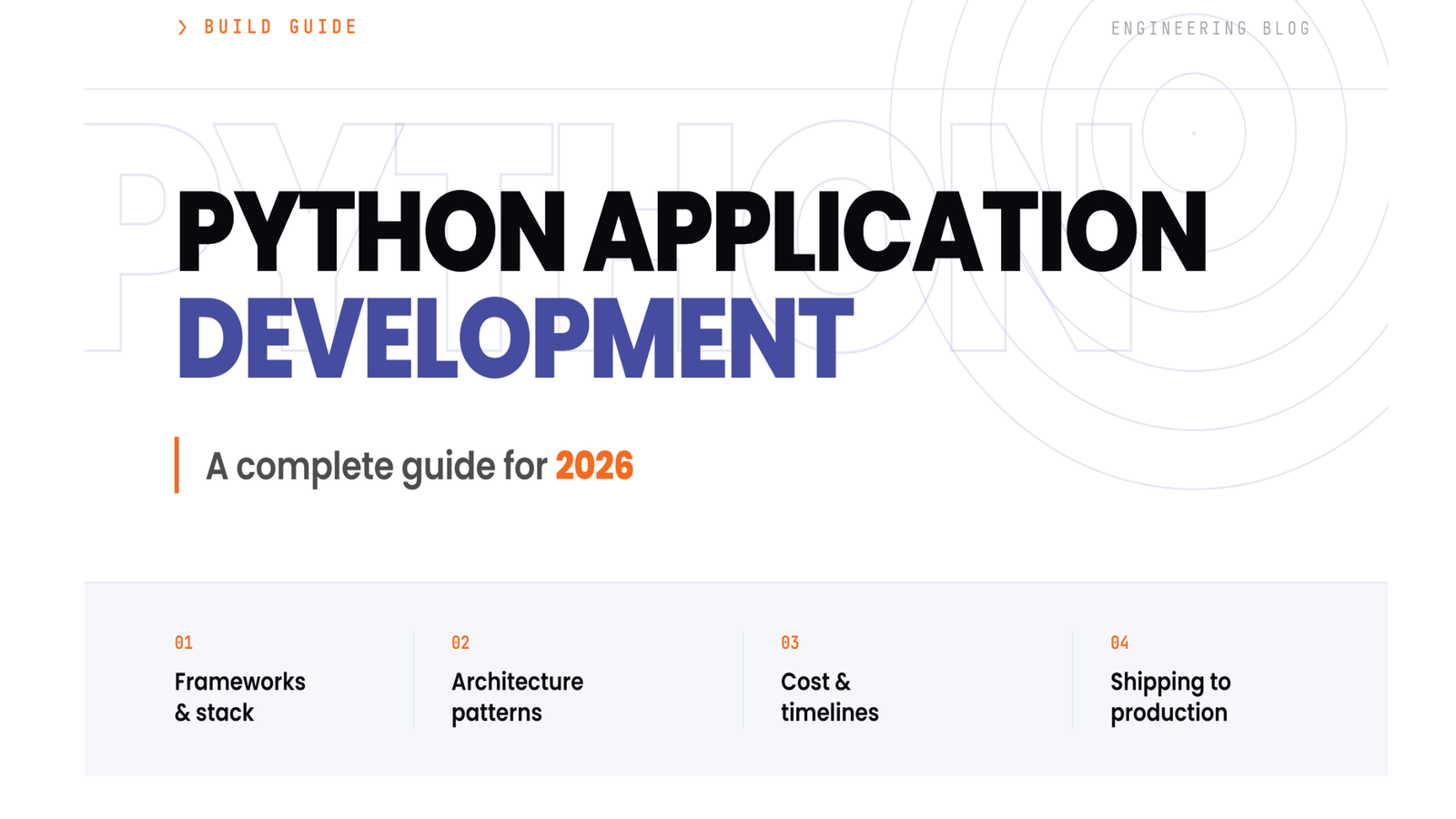
This guide covers what Python application development actually involves, the frameworks and tools that matter in 2026, the types of applications Python is genuinely well suited for, what drives cost, and how to evaluate a Python app development company before you sign a contract. Along the way, we'll point to how Xororaapproaches each piece of this, since it's the same evaluation lens we'd want a client to use on us.
What is Python application development?
Python application development is the process of building software, web applications, backend systems, automation tools, or data-driven products using Python as the core programming language. Python's appeal comes down to a few consistent strengths: readable, concise syntax that speeds up development and long-term maintenance, a mature standard library, and one of the largest open-source ecosystems in software, covering everything from web frameworks to machine learning libraries.
That combination is why Python shows up across such a wide range of use cases. A team doesn't need to switch languages between building a REST API, automating a data pipeline, and prototyping a machine learning model. That consistency matters more than it sounds like on paper: it reduces hiring complexity, simplifies onboarding, and keeps a smaller team productive across more of the stack, which is a large part of why Xorora structures its own engineering practice around Python as a connective layer between application code and AI/ML work, rather than treating them as separate disciplines.
Python frameworks worth knowing in 2026
Framework choice shapes almost everything about a Python project's architecture, so it's worth understanding what each one is actually built for.
Django
Django remains the standard choice for full-featured web applications and platforms that need a lot out of the box: an ORM, an admin interface, authentication, and a strong security posture by default. It suits content-heavy sites, SaaS platforms, and applications with complex data models.
FastAPI
FastAPI has become the go-to for modern, high-performance APIs. Built around Python's async capabilities and automatic OpenAPI documentation, it's a strong fit for microservices, mobile app backends, and any system where request throughput matters — and it's one of the frameworks behind Xorora's own real-time SaaS event monitoring work.
Flask
Flask is a lightweight microframework for smaller applications or services that don't need Django's full feature set. It gives a team more architectural control at the cost of having to assemble more pieces manually.
Kivy and BeeWare
Kivy and BeeWare extend Python into cross-platform mobile and desktop UI development, letting teams write once and target Android, iOS, and desktop from a shared Python codebase — useful for internal tools and certain consumer apps where a fully native experience isn't a hard requirement.
Celery
Celery handles asynchronous task queues and background job processing, a near-standard component in Python applications that need to offload heavy or time-delayed work (sending emails, processing uploads, running scheduled jobs) outside the main request cycle.
Where Python application development actually fits
Python isn't the right tool for every project, but it's a strong fit across a wider range of application types than most languages:
- Web applications and SaaS platforms, built on Django or FastAPI, handling everything from user-facing product logic to complex backend workflows
- Data-driven applications and internal tools, where Python's data ecosystem (pandas, NumPy) integrates directly into the application layer
- AI and machine learning-powered products, where Python is effectively the industry standard for training, deploying, and serving models — an area covered directly by Xorora's ML and data science services
- Automation and system administration tools, where Python's readability and scripting strength reduce long-term maintenance burden
- API-first backends and microservices, particularly with FastAPI, serving mobile apps, third-party integrations, or a separate frontend
- Fintech and regulated-industry applications, where Python's mature libraries for data validation, security, and compliance tooling reduce custom-build overhead
The common thread: Python performs best when a project needs to move data, logic, and increasingly AI capability cleanly through one coherent stack, rather than stitching together several languages for different layers. It's the same reasoning behind Xorora's custom application development approach.
What drives the cost of Python application development
Application complexity
Application complexity is the single biggest factor. A scoped internal tool or MVP costs meaningfully less than a multi-tenant SaaS platform with billing, authentication, and third-party integrations.
Framework choice
Framework choice affects both build speed and long-term cost. Django's batteries-included approach can reduce initial build time for data-heavy applications; FastAPI's leaner footprint suits API-first projects where speed and performance matter more than built-in tooling.
AI/ML integration
AI/ML integration adds real engineering time beyond the core application. Model integration, data pipeline work, and ongoing evaluation aren't one-time costs — they're an ongoing part of the system.
Team seniority
Team seniority affects both hourly rate and total project cost. Senior engineers cost more per hour but tend to make fewer costly architectural mistakes on complex builds, which often lowers total cost even at a higher rate — or you can bring senior Python capacity into an existing team through a staff augmentation model instead of a full handoff.
Integrations and third-party services
Integrations and third-party services (payments, CRMs, external APIs) add both build and testing time regardless of the underlying framework.
Because of how much these factors vary, a credible Python application development company offering python app development services should be able to give you a written estimate against your actual scope rather than a generic price range that doesn't reflect your project.
How to choose a Python app development company
Ask for real, production Python applications, not just a list of frameworks on a services page. A working demo and a system handling real production traffic are very different things.
Confirm framework depth against your specific needs. A team fluent in Django may not have deep FastAPI experience, and vice versa. Ask directly about the framework your project actually needs.
Check their approach to testing and deployment. Python's testing ecosystem (pytest, unittest) is mature; a team should have a clear, consistent testing strategy, not an ad hoc one.
Ask how AI or data features fit into their process, if your roadmap includes them. A growing share of Python projects now need a machine learning or AI layer somewhere in the system, and a team that handles both application development and AI/ML avoids the friction of coordinating two separate vendors.
Clarify ownership and documentation terms before signing. Source code, infrastructure access, and technical documentation should be unambiguous from day one.
Python application development at Xorora
Xorora is a US-based AI development partner offering Python application development services built for teams that need software to reach production, not just a working prototype. Our Python work spans Django and FastAPI backends, Flask microservices, REST API development, and the data and AI/ML layers that increasingly sit behind modern applications.
What sets Xorora apart as a Python application development company is that Python sits inside a broader AI-capable engineering practice, not a standalone service. Recent engagements have included multi-portal SaaS backends built on a single shared architecture and a real-time compliance intelligence platform. Publicly cited results from that body of work include a 3.5x median speed-up compared to building the same system in-house and 99.9% uptime across deployed systems.
Python-related capabilities at Xorora
- Python application development (Django, FastAPI, Flask)
- REST APIs and microservices
- AI/ML integration
- Data pipelines and automation
- Application modernization for legacy Python systems
- Cloud-native deployment
A $10,000 minimum project size keeps the door open for a scoped MVP or a single Python service, not only large enterprise programs. If you're scoping a Python project, get in touch for a written estimate against your actual requirements.
Frequently asked questions
Q1: What is Python application development used for?
Python application development covers web applications, SaaS platforms, internal tools, data-driven systems, automation, and AI/machine learning-powered products. Its versatility means a single team can often handle backend logic, data processing, and AI integration in one coherent stack.
Q2: How much do Python application development services cost?
Cost depends primarily on scope: application complexity, framework choice, integrations, and whether AI/ML features are involved. A scoped API or internal tool costs meaningfully less than a full-stack SaaS platform with billing and third-party integrations. Get a written estimate against your specific requirements rather than relying on a generic price range.
Q3: Which Python framework should I use for my application?
Django suits full-featured web applications and platforms with complex data models. FastAPI is the stronger choice for modern, high-performance APIs and microservices. Flask fits smaller applications where you want more architectural control. The right choice depends on your project's specific requirements, not a universal best answer.
Q4: What should I look for in a Python app development company?
Real production experience with the framework your project needs, a documented testing and deployment process, and clarity on how AI or data features fit in if your roadmap includes them. Ask for examples of applications currently running in production, not just a portfolio of demos.
Q5: Is Xorora a good choice for Python application development?
Xorora builds Python applications — Django and FastAPI backends, REST APIs, and AI/ML-integrated systems — for startups and mid-market companies, alongside its broader full-stack and AI engineering practice. Projects start at $10,000, with pricing quoted directly against scope rather than a generic rate card.
Related
Related articles
Best Custom AI Firms for SaaS Products Compared (2026)
Software Development·12 min read
Compare AI software development companies for SaaS on design capability, deployment capability, and scaling capability across the full AI agent lifecycle.
Oct 2, 2026
Best AI Agent Providers for Agency Client Automation (2026)
Software Development·12 min read
Compare AI agent development services for agencies on deployment repeatability, per-client customization, and operational reliability at scale.
Sep 30, 2026
The Complete Guide to Custom AI Services for SMBs (2026)
Software Development·11 min read
A practical guide to custom AI development services for SMBs — workflow automation, software integration, evaluation criteria, and measurable outcomes.
Sep 14, 2026